Immortality
The Moon and the SunImmortality is not established as a fact in the novel but pursued as a claim about the sea monster, a problem of evidence, and a temptation bound up with Louis XIV’s understanding of his own rule. The proposed organ gives that abstract desire a physical location: Yves de la Croix finds an anomalous structure in the creature’s lung, and Louis XIV immediately treats the discovery as confirmation. Yet the tissues Marie-Josèphe later studies look ordinary, and neither the organ’s function nor the possibility of everlasting life is demonstrated. The gap between royal certainty and natural-philosophical proof keeps immortality unresolved.
A question of evidence
At the dissection, Yves de la Croix begins by describing what the sea monster shares with known animals. Its muscles and bones have counterparts among other furred creatures. Louis XIV redirects him: the King wants what is unique. When Yves opens the chest, he finds no gills or swim bladder, and describes the creature’s internal organs as normal for a mammal, much like those of a dugong. The King makes clear that classification as fish or beast does not answer his real question. He is looking for an organ of immortality.
Yves reports that he has found no evidence of such an organ. He distinguishes the search for a physical structure from the alchemical promise of immortality, placing the latter alongside the transmutation of gold as a matter abhorred by both the Church and natural philosophy. His answer is cautious rather than absolute: whether the organ exists is a question to be tested, and his private beliefs do not settle it. For Louis XIV, however, the King’s challenge is personal as well as empirical. He suggests that disbelief itself could prevent Yves from finding what he seeks, pressing the natural philosopher to explain why he accepted the undertaking if he thinks the goal futile.
Yves answers with the practical reason that he wanted to please Louis XIV, while maintaining that the sea-monster quest itself was not futile. The exchange exposes two different standards of conviction. Louis XIV treats ancient reports as grounds for continuing the search; Yves distinguishes a possibility from evidence that it has been realized. Their disagreement does not stop the dissection, but it makes the meaning of any discovery contentious before the organ is even exposed.
Royal power and religious uncertainty
Louis XIV’s interest in immortality exceeds curiosity about anatomy. When Yves asks why sailors who consumed sea monsters would not live for a thousand years, the King replies that hard lives expose sailors to accidents and drowning, dangers that protection from age and disease would not prevent. His answer keeps the claim alive by separating longevity from invulnerability: a supposed defense against aging would not shield its possessor from every cause of death.
Pope Innocent offers a different framework. He recalls humanity’s expulsion from Eden, where people had been immortal, and places present mortality within the hope of everlasting life with God. Earthly immortality, he says, would be a burden rather than a satisfaction. Yet he hesitates over the possibility that someone called to continue God’s work might submit to that burden. Louis XIV immediately presents himself as such a person. The scene does not establish that the Pope endorses the King’s ambition; it shows religious uncertainty being drawn into the King’s argument for himself.
The political implications also appear through Lucien de Barenton, Count de Chrétien’s private hopes. After the secret dissection, he considers what might follow if Louis XIV never died: the realm might avoid the reign of Monseigneur, escape Madame de Maintenon’s influence, restore the Edict of Nantes, and cease making war on its own people. These are Lucien’s imagined consequences, not outcomes secured by the discovery. His hopes reveal how the King’s possible survival becomes entangled with the future of the realm. The question is no longer only how long one body might endure, but what an undying sovereign could preserve or prolong.
The anomalous organ
During the dissection, Yves cuts open the rib cage with heavy shears and examines the lungs, heart, and glands. He moves the lung lobes aside and finds an unusual structure attached to the lung. When he lifts it and cuts it free, Louis XIV declares that Yves has found the organ. The King’s certainty follows the act of discovery at once, but the exchange supplies no test showing that the structure grants life without end. Its name and significance remain a hypothesis attached to an anatomical difference.
Marie-Josèphe’s later examination makes that uncertainty tangible. The sea monster’s organs, including the anomalous lung lobe, lie preserved in spirits in heavy glass jars. To her, the tissue looks quite ordinary, no different from that of a porpoise she and Yves had dissected after it stranded on the shore at home. She wonders whether an organ of immortality ought to shine or glow gold, but the question expresses an expectation, not a finding. She has never believed in either transmutation or immortality; observation, description, deduction, and interaction speak more convincingly to her.
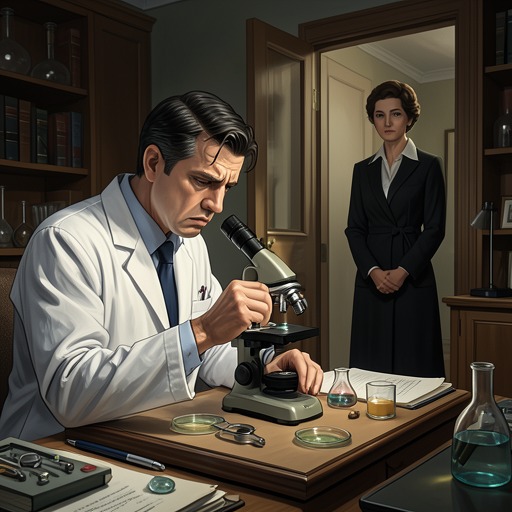
She prepares samples from the kidney, liver, pancreas, and lung, mounts them, and draws each carefully using Yves’s old microscope. The instrument has been damaged by the sea voyage, so she hopes Van Leeuwenhoek might sell her one of his lenses, said to be the best in the world but difficult to focus. When she prepares a sample of the anomalous lung, she does find a material distinction: its texture is firmer and its tissue denser than ordinary lung. That difference supports further investigation, but it does not establish what the structure does. The novel keeps the organ between visible anatomical variation and the King’s desired proof.
Mortality without resolution
The competing responses to immortality remain in view after the dissection. Louis XIV’s desire is connected to a future in which his own reign and purposes continue; Pope Innocent weighs bodily persistence against the spiritual hope of everlasting life; Yves insists that the question must be answered through evidence; and Marie-Josèphe subjects the preserved tissue to direct observation. Their positions do not collapse into a single verdict. Even Yves’s discovery leaves open whether the structure is the organ the King names, while Marie-Josèphe’s firmer, denser sample identifies a difference without explaining its function.
The idea therefore works less as a confirmed supernatural property than as a test of how people interpret uncertain evidence. Louis XIV reads the unusual structure through the possibility he needs; Yves separates discovery from proof; the Pope measures earthly survival against religious belief; and Marie-Josèphe attends to what can actually be seen and described. The organ makes immortality seem nearly touchable, preserved in a jar, yet the decisive question—whether it can confer everlasting life—remains unanswered.